
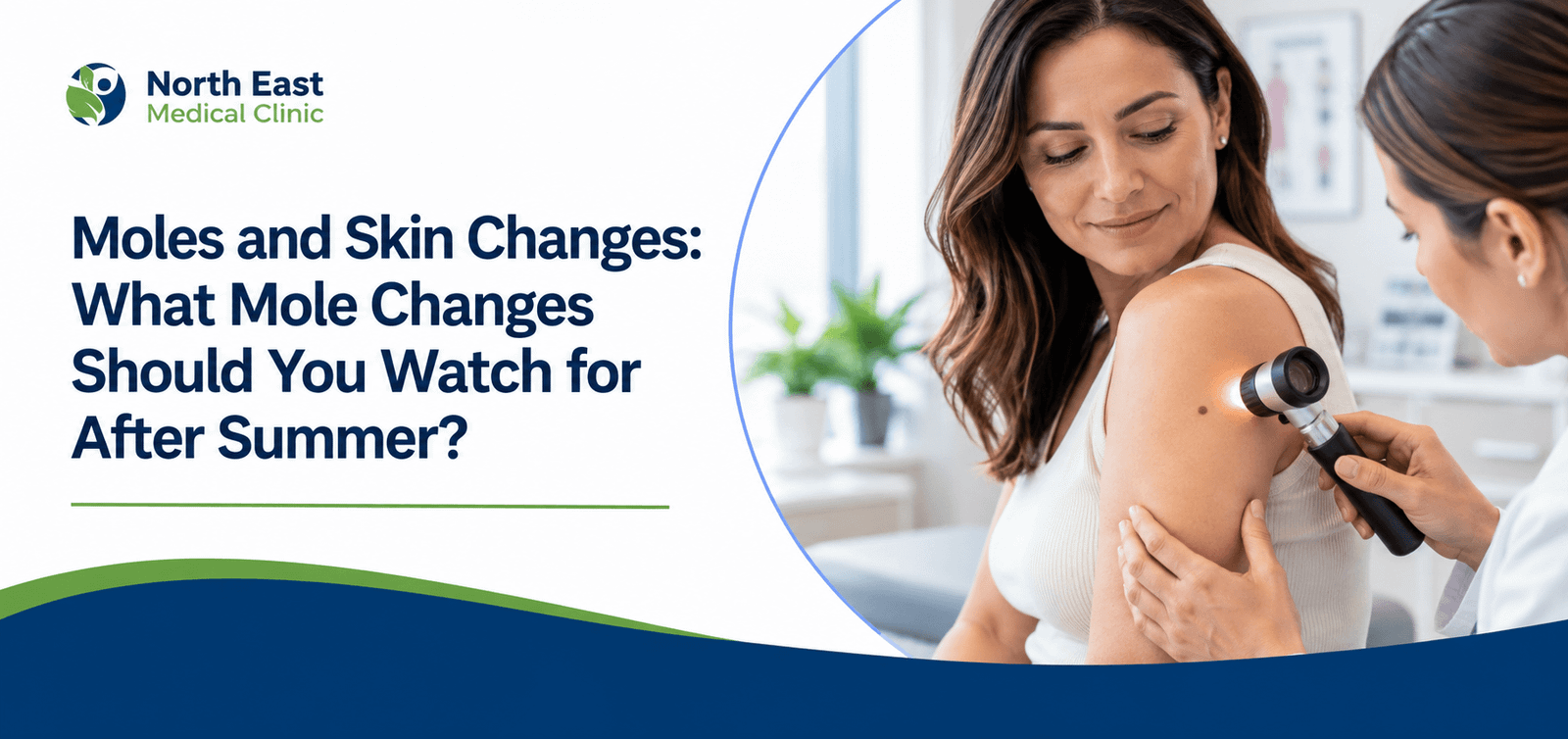
After a summer spent outdoors, early fall can be a useful time to check your skin. Sunburns, tanning, and repeated exposure to ultraviolet radiation can damage skin over time. Although most moles and skin spots are harmless, certain mole changes should be assessed by a healthcare professional.
Watch for a new spot or a mole that changes in size, shape, colour, height, texture, or sensation. A spot that bleeds, crusts, itches, or does not heal also deserves medical attention.
A visual check cannot diagnose skin cancer. However, knowing what is normal for your skin can help you recognize a change that may require a closer examination.
Why Check Your Moles After Summer?
Ultraviolet radiation from the sun can damage skin cells. A tan and a sunburn are both signs that the skin has been affected by UV exposure. Skin damage can accumulate over a lifetime, which is why sun protection remains important even if previous sunburns have healed.
Checking your skin after summer may help you notice:
- A mole that looks different from earlier in the year
- A new spot or growth
- Changes in a long-standing mole
- A sore that has not healed
- A patch that repeatedly bleeds, crusts, or becomes irritated
A change does not necessarily mean skin cancer. Moles and other growths can change for several non-cancerous reasons. A medical assessment is needed to determine whether a spot requires monitoring, testing, or further care.
What Mole Changes Should You Watch For?
The ABCDE guide is commonly used to identify features that may warrant assessment. According to the Canadian Cancer Society , a change in the colour, size, or shape of a mole can be an early sign of melanoma.
A: Asymmetry
One half of the mole does not match the other half in shape, colour, or thickness.
Many harmless moles are round or oval and relatively symmetrical. An asymmetrical appearance does not confirm cancer, but it is a reason to have the mole examined.
B: Border
The edges may appear:
- Uneven
- Jagged
- Notched
- Scalloped
- Blurred
- Poorly defined
Pay attention if a previously smooth border becomes irregular or appears to spread into the surrounding skin.
C: Colour
A mole may need assessment if it develops several colours or changes from its usual colour.
Concerning colour patterns may include combinations of:
- Brown
- Black
- Red
- Pink
- White
- Blue
- Grey
Melanoma can look different across skin tones. Do not rely on colour alone when deciding whether a spot requires medical attention.
D: Diameter
A mole larger than approximately six millimetres, about the size of a pencil eraser, may warrant attention.
Size alone does not determine whether a mole is concerning. Some harmless moles are larger than six millimetres, while some melanomas may be smaller. Changes in size or other characteristics are also important.
E: Evolving
“Evolving” means the mole is changing over time. This is one of the most important mole changes to monitor.
Watch for changes in:
- Size
- Shape
- Colour
- Height
- Texture
- Sensation
New itching, tenderness, burning, bleeding, oozing, or crusting should also be discussed with a healthcare professional.
What Is the “Ugly Duckling” Sign?
Most of a person’s moles tend to share similar features. A spot that looks noticeably different from the others is sometimes called an “ugly duckling.”
For example, consider requesting an assessment if one mole is:
- Much darker than your other moles
- A different shape or texture
- Growing while the others remain stable
- The only new mole or unusual spot in an area
- Changing in a way that stands out
This observation does not diagnose melanoma. It is simply another reason to ask a healthcare professional to examine the area.
Other Skin Changes That May Need Assessment
Not all skin cancers begin as moles. Contact a healthcare professional if you notice:
- A new growth that continues to enlarge
- A sore that does not heal
- A spot that repeatedly bleeds or crusts
- A firm lump or raised growth
- A scaly patch that persists
- A shiny, pearly, or translucent bump
- An open sore that heals and returns
- A dark line or changing pigment under a nail
- A new or changing spot on the palms, soles, or between the toes
Many non-cancerous skin conditions can cause similar changes. An examination is needed to distinguish between harmless growths, inflammatory conditions, infections, and lesions that may require further investigation.
How to Check Your Skin at Home
Choose a well-lit room and use a full-length mirror and a hand mirror. Check the entire surface of your skin rather than only the areas that received the most sun.
Remember to examine:
- Face, ears, neck, and scalp
- Chest, abdomen, sides, and back
- Arms, hands, fingers, and nails
- Underarms
- Legs and behind the knees
- Feet, soles, toes, and toenails
- Buttocks and groin area
Skin cancer can occur on areas that receive little or no regular sun exposure.
Keep a Record of Mole Changes
A dated photograph may help you track whether a spot is changing. Take the photo in consistent lighting and include a ruler or another size reference beside the mole.
A photograph is only a monitoring tool. It should not delay an assessment if a spot is bleeding, rapidly changing, painful, or otherwise concerning.
Avoid trying to diagnose a lesion from an image or online comparison. Different skin conditions can appear similar in photographs.
Who May Need More Regular Skin Checks?
Speak with a healthcare professional about an appropriate skin-check schedule if you have:
- Many moles
- Atypical or irregular-looking moles
- A personal history of melanoma or another skin cancer
- A close family history of melanoma
- A history of blistering sunburns
- Significant lifetime sun exposure
- Regular exposure to indoor tanning equipment
- A condition or treatment that affects immune function
Having one or more risk factors does not mean you will develop skin cancer. It may mean that more structured monitoring or professional skin examinations are appropriate.
When Should You See a Doctor About a Mole?
Arrange an appointment if you notice:
- A new or rapidly changing mole
- A change in a mole’s size, shape, colour, or height
- An irregular or blurred border
- Several colours within one spot
- New itching, pain, tenderness, or burning
- Bleeding, oozing, crusting, or ulceration
- A sore that does not heal
- A spot that looks noticeably different from your other moles
- Any skin change that concerns you
The Government of Canada advises seeing a healthcare provider promptly for bleeding, crusting, or changes in the colour, size, or shape of a mole. North East Medical Clinic also provides medical skin assessments in Calgary for moles, lesions and other medical skin concerns.
Do not wait until a mole becomes painful. Concerning skin lesions may not cause discomfort.
What Happens During a Medical Skin Assessment?
During an assessment, a healthcare professional may ask about:
- When you first noticed the spot
- Whether it has changed
- Previous sunburns or indoor tanning
- Personal or family history of skin cancer
- Symptoms such as itching or bleeding
- Medications and conditions that affect immune function
The clinician may examine the spot and surrounding skin. Dermoscopy may be used when appropriate. A dermoscope provides light and magnification to help a trained clinician view structures that cannot be assessed as clearly with the unaided eye.
A skin examination or dermoscopy cannot always provide a final diagnosis. If a lesion appears concerning, the clinician may recommend monitoring, biopsy, removal, or referral based on the assessment.
North East Medical Clinic provides Medical Skin Assessments and mole evaluations , including dermoscopic assessment when clinically indicated. Services are medical rather than cosmetic and are subject to referral requirements, availability, and clinical appropriateness.
Can a Walk-In Clinic Assess Mole Changes?
A family or walk-in physician can provide an initial assessment of a new or changing skin concern. The physician may recommend monitoring, arrange testing, or refer you for a more detailed medical skin assessment.
North East Medical Clinic offers walk-in medical care in Calgary NE for eligible non-emergency concerns based on physician availability and clinical priority.
Call ahead to confirm whether the appropriate physician or service is available for your concern.
How Can You Protect Your Skin After Summer?
Sun protection remains important throughout the year. UV radiation can still reach your skin during cooler or cloudy weather and can reflect from snow.
Protective steps include:
- Seeking shade when UV levels are high
- Wearing a wide-brimmed hat and protective clothing
- Applying broad-spectrum, water-resistant sunscreen
- Reapplying sunscreen according to its directions
- Protecting your lips with an SPF lip balm
- Avoiding tanning beds and sun lamps
- Checking your skin regularly for changes
Ask a pharmacist or healthcare professional for guidance if you are unsure which sunscreen is appropriate for your skin, medications, or medical conditions.
Medical Skin Assessments in Northeast Calgary
Most moles are harmless, but new or evolving mole changes should not be ignored. A medical assessment can help determine whether a spot can be monitored or requires further investigation.
North East Medical Clinic provides medical skin assessments for eligible concerns, including mole and lesion evaluation and dermoscopy when indicated. You can review the clinic’s medical team or use the online booking page to request a non-urgent appointment.
Do not include photographs, detailed symptoms, or sensitive medical information in the online booking form. Contact the clinic to confirm referral and appointment requirements.
Request a non-urgent appointmentFrequently Asked Questions
What mole changes should I be concerned about?
Watch for changes in size, shape, colour, border, height, texture, or sensation. A mole that becomes itchy, painful, crusted, or begins to bleed should also be assessed.
Does a changing mole always mean skin cancer?
No. Moles can change for non-cancerous reasons. However, a healthcare professional should evaluate new, evolving, or otherwise unusual changes.
Can melanoma be smaller than six millimetres?
Yes. Although diameter is part of the ABCDE guide, melanoma can be smaller than six millimetres. Evolution and other unusual features are also important.
Can skin cancer occur on skin that is not exposed to the sun?
Yes. Concerning lesions can appear on the scalp, soles, palms, between the toes, under the nails, and other areas that receive limited sun exposure.
What is dermoscopy?
Dermoscopy is a non-invasive examination that uses a specialized light and magnifying instrument to view structures within a skin lesion more clearly. Further testing may still be required if a lesion appears concerning.
Do I need a referral for a medical skin assessment?
Referral and booking requirements can depend on the service and clinical concern. Contact North East Medical Clinic to confirm the current referral process and appointment availability.
This article provides general educational information and does not replace a medical examination, diagnosis, or treatment. Contact a qualified healthcare professional about new, changing, or concerning skin lesions.